
When Honda Motorcycle & Scooter India entered the electric scooter market, expectations were sky-high. After all, the petrol Honda Activa is one of India’s most trusted two-wheelers.
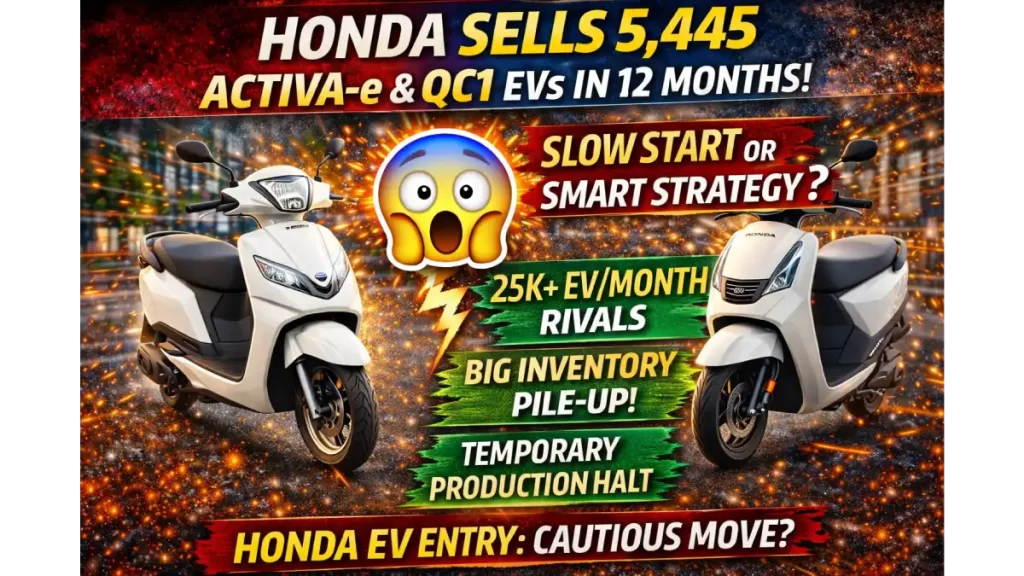
But in its first 12 months, Honda’s electric twins — Activa-e and QC1 — recorded 5,445 units dispatched to dealers. For a brand with Honda’s scale, that number feels modest. Yet, the full picture tells a more layered story about cautious production, dealer inventory, and India’s evolving EV ecosystem.
While rivals are clocking big monthly volumes, Honda’s EV journey seems more measured than aggressive. So is this a disappointing debut — or a calculated first step? Let’s break it down.
The Numbers Explained
Production vs Sales
- Total production (12 months): 11,000+ units
- Dispatched to dealers: 5,445 units
- Retail deliveries: Around 3,700+ units
That gap between production and retail tells us one thing clearly — inventory movement has been slower than expected.
Why the Slower Uptake?
- Limited EV dealership footprint initially
- Swappable battery system rollout still developing
- Buyers comparing aggressively with established EV rivals
In short, Honda didn’t flood the market — it entered carefully.
Activa-e vs QC1: Two Different Approaches
Activa-e
- Positioned as a more advanced offering
- Focused on battery swapping ecosystem
- Availability limited to select cities
QC1
- Simpler fixed-battery design
- Home charging friendly
- Easier for first-time EV buyers
Industry observers note that QC1 appears to be the stronger seller among the two, largely because Indian buyers still prefer simple home charging over battery swapping networks.
How It Compares to the Market
India’s electric two-wheeler market has grown rapidly, with brands like TVS Motor Company, Bajaj Auto, and Ather Energy posting strong monthly numbers.
Compared to those players, Honda’s 5,445 dispatches in a full year look conservative. But context matters:
- Honda is still scaling EV infrastructure
- Its ICE dominance doesn’t automatically convert into EV adoption
- EV buyers prioritize range, charging access, and service readiness
This first year feels more like market learning than market domination.
What This Means for Buyers
For everyday commuters and family riders, Honda’s entry proves one thing — even legacy brands must adapt quickly in the EV era.
If You’re a Buyer:
- Honda’s EV models are backed by brand trust
- But charging ecosystem and availability may vary by city
- Rivals currently offer wider EV portfolios and faster delivery timelines
Experts believe Honda may revise strategy, expand dealer coverage, and refine pricing in coming months.
📌 Key Takeaways
- 5,445 units dispatched in 12 months
- Retail movement slower than initial expectations
- Production paused temporarily due to inventory balancing
- Honda still in its early EV expansion phase
If you’re considering a Honda electric scooter, check availability and charging support in your city before booking. And if you’re watching the EV market closely, Honda’s next move could be far more aggressive than its first year suggests.
🔁 Think Honda can bounce back stronger in EVs?
Share this article or save it — the next 12 months could redefine Honda’s electric story in India.