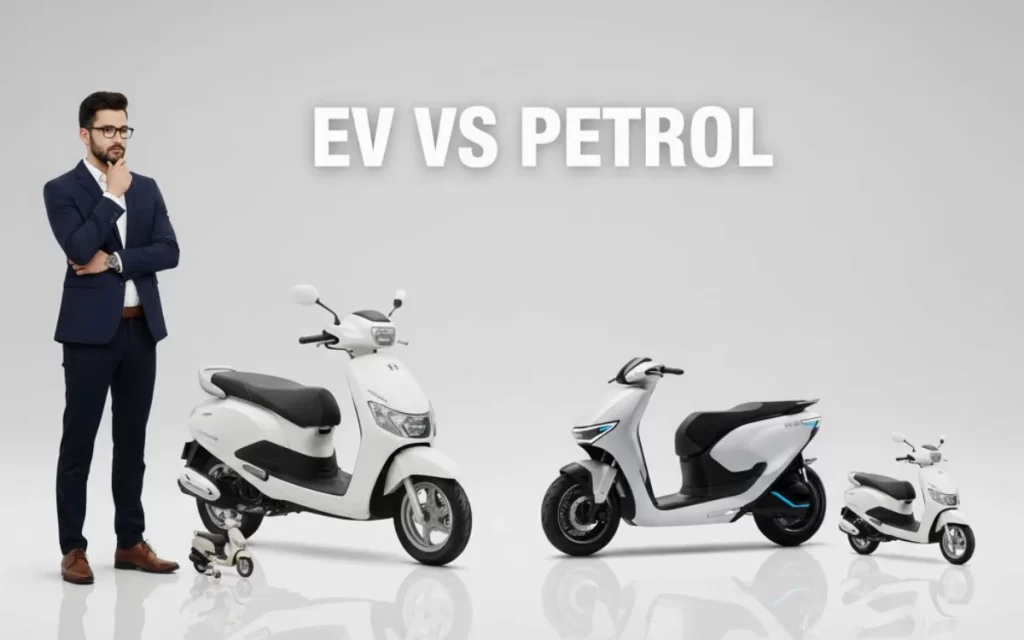

Is it worth buying electric scooter over petrol in India in 2026? This is one of the most common questions among city riders today—and the short answer is yes, for most urban commuters, it absolutely is. Especially if your daily travel is within 30-50 km, an electric scooter will be more financially and practically viable than a petrol scooter, even with the higher initial price.
With falling battery costs, improved real-world range, and government incentives, the gap between EVs and petrol scooters has narrowed sharply. In fact, when you look beyond the showroom price and focus on ownership costs, electric scooters are already ahead.
Why Electric Scooters Are Winning the Cost Battle
When comparing electric scooter vs petrol scooter India, running cost is the biggest game-changer. The price of petrol is around 100–105 rupees per liter, but the electricity used to power the vehicle is still very cheap.
The cost of a petrol scooter averaging 45 kmpl would be approximately Rs. 2.5–3 per km. In contrast, the cost of an electric scooter is only Rs. 0.25–0.50 per km, depending on the electricity tariffs. The differences now become huge over time.
For someone who rides 30 km a day, the cost of petrol alone will cross Rs. 75,000 in three years. The charging cost of an electric vehicle for the same distance is almost Rs. 7,500. This factor has a great influence on the debate about the ev vs petrol running cost 2025 – the latter being nearly 90% cheaper.
Maintenance is another hidden saving. There are no differentials, no engine oil, no spark plugs, and no exhaust in electric scooters. Over three years, a petrol scooter will cost around Rs 15,000–18,000 for maintenance, while an electric vehicle will only be close to Rs 2,000.
READ HERE: How to Choose Electric Scooter for Commute
Electric Scooter Ownership Cost: The Real Picture
Many consumers are in doubt because of the higher upfront prices, but a total ownership account shows a different story. That extra sum of money is recovered in 2-3 years, even if the initial cost of an electric scooter is higher by Rs 30,000 only. This is the average Indian daily commuter’s break-even point for EV scooters.
After 3 years, the overall expenditure on an EV will be lower by approx. Rs 50,000–55,000 as compared to that on a petrol scooter. Better resale value can also be considered as a financial advantage. EVs have a retention rate of 60-70% as compared to that of 40-50% for petrol scooters – thus, the money-saving game gets more apparent.
Utilizing an electric scooter ownership cost calculator, EVs will always be a better option than petrol ones for urban use.
Performance & Daily Practicality in Indian Cities
Modern electric scooters are no longer slow or limited. Instant torque makes them quicker off the line than petrol scooters, especially in traffic. This is where petrol scooter vs electric scooter mileage becomes less relevant, because EVs convert energy more efficiently.
The majority of electric scooters now have a certified range of 100–170 km and a real-world range of 80% of that. It is more than enough to cover 90% of the daily commuting distances in cities. For those asking is electric scooter worth buying for office travel—the answer is yes, if you can charge at home.
Charging for 5–6 hours overnight is enough for most users. Also, there is rapid growth in public charging station numbers in metro cities, thus, there is less range anxiety every year.
Explore fastest affordable electric scooters for city traffic in India
When Petrol Scooters Still Make Sense
Despite the benefits, EVs are not ideal for everyone. If you regularly ride more than 100 km per day, especially on highways, petrol still offers convenience. Lack of home parking or charging access can also increase EV running costs.
In rural or semi-urban areas, petrol pumps remain more accessible than chargers. Also, buyers with very tight budgets under ₹80,000 may still find petrol scooters more practical in the short term.
Therefore, petrol vs EV scooter maintenance cost is secondary to accessibility and usage pattern in this case.
Environmental & Future-Proof Advantage
Electric scooters produce zero tailpipe emissions, helping reduce urban air pollution. With India targeting 30% EV adoption by 2030, policy support is only expected to increase. Petrol taxes, meanwhile, are unlikely to come down.
Battery warranties of 5–8 years have lessened the long-term risk factor while new technologies are constantly making batteries more durable. For city riders, there is no doubt; EVs are the future.
Verdict: Should You Buy EV Scooter Over Petrol?
If your daily commute is less than 80 km, you live in a city, and you have access to home charging, then the answer to the question “should I buy EV scooter over petrol?” is definitely yes. Over three years, EVs save money, offer smoother rides, and are better aligned with future mobility trends.
For buyers looking at EV SCOOTER UNDER 1LAKH, options are improving rapidly, making electric mobility more accessible than ever.
FAQs
Is it worth buying electric scooter over petrol in India?
Yes, especially for city riders. Lower running and maintenance costs make EVs cheaper over time.
What is the electric vs petrol scooter 3 year cost difference?
Electric scooters can save ₹50,000–₹60,000 over three years for daily commuters.
Which is the best EV for daily commute India?
For urban use, electric scooters with 100+ km range and home charging are ideal.
Are electric scooters reliable long term?
With battery warranties up to 8 years, reliability concerns have reduced significantly.
Do petrol scooters still have advantages?
Yes, for long-distance travel, rural areas, or where charging access is limited.
Final Thought: Electric scooters have moved beyond the phase of being just an experiment—they are a financially wise choice for the majority of urban commuters in 2025. If your usage pattern matches, then switching right away would mean both saving money and being future ready.