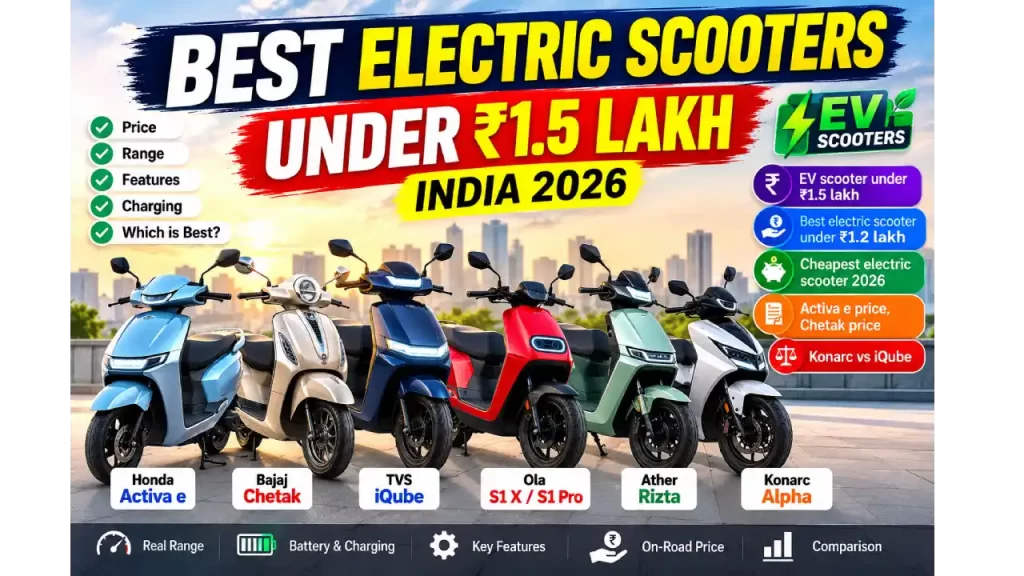

Buying an electric scooter under ₹1.5 lakh in 2026? Good news — this budget now covers almost the entire mainstream EV scooter market, from the ₹85,000 Ola S1 X all the way up to premium family scooters. In this guide, we’ve compared the top 10 EV scooters under ₹1.5 lakh on price, range, charging time, top speed, real-world usability and long-term ownership costs, so you can pick the right one in a single read.
Quick Comparison: Top 10 Electric Scooters Under ₹1.5 Lakh
| Rank | Model | Ex-Showroom Price | Claimed Range | Top Speed | Charging Time |
|---|---|---|---|---|---|
| 1 | Ola S1 X (3 kWh) | ₹84,999 | 143 km | 90 km/h | ~6.5 hrs |
| 2 | Ather Konarc S | ₹1,01,999 | 100 km | 70 km/h | ~4.5 hrs |
| 3 | Vida VX2 | ₹1,09,990 | 93–128 km | 70 km/h | ~62 min (fast) |
| 4 | Bajaj Chetak | ₹1,19,270 | 131–153 km | 70–80 km/h | ~4 hrs |
| 5 | TVS iQube | ₹1,20,124 | 94–123 km | 68–82 km/h | ~2.7 hrs |
| 6 | Honda Activa e | ₹1,20,133 | 102 km | 80 km/h | 6 hrs / battery swap |
| 7 | Ather Rizta | ₹1,21,549 | 123–161 km | 80 km/h | ~5 hrs |
| 8 | Honda QC3 | ₹1,35,000 | 145 km | 80 km/h | ~4 hrs |
| 9 | Hero Mavrick 440 EV* | ~₹1.4 lakh est. | ~120 km | 80 km/h | ~4 hrs |
| 10 | Ampere Magnus Neo | ₹92,900 | 125 km | 55 km/h | ~5–6 hrs |
*Estimated/on-road figures may vary. Prices ex-showroom, October 2026.
Prices ex-showroom, October 2026. On-road price varies by state (EV subsidy + registration). *Upcoming/estimated — verify before purchase.
1. Ola S1 X (3 kWh) — Best Budget Electric Scooter
The S1 X makes EV ownership genuinely affordable. The 3 kWh variant at ₹84,999 offers 143 km claimed range and 90 km/h top speed — specifications that embarrass scooters costing ₹40,000 more.
Pros: Lowest price in the high-speed segment; long claimed range; multiple variants to choose from
Cons: Build quality and service consistency trail Bajaj/TVS/Honda; claimed range is optimistic
Verdict: Maximum scooter per rupee. Acceptable trade-offs if budget is your hard limit.
2. Ather Konarc S — Best Overall Under ₹1.5 Lakh
India’s current best-selling electric scooter. The Konarc S at ₹1,01,999 delivers 100 km claimed range, and higher variants (still under ₹1.5 lakh for mid trims) stretch to 200 km. Ather’s software and connected features are the most mature in the industry.
Pros: Best-selling for a reason — range, features, software, growing fast-charge network
Cons: 70 km/h top speed caps highway use; base variant range is modest
Verdict: The default recommendation for most buyers in this budget.
3. Vida VX2 — Best If You Can’t Install a Home Charger
Hero’s Vida VX2 offers removable batteries — carry them to your apartment and charge from any socket. Fast charging tops the pack in about an hour at Vida stations.
Pros: Battery portability solves apartment charging; quick fast charge; Hero service network
Cons: Real-world range on the lower side; fast-charge network still growing
4. Bajaj Chetak — Best Build Quality
Full-metal body, classic design, and Bajaj’s massive service footprint. The Chetak is the buy-it-and-keep-it-for-a-decade choice. Base C2501 variant sits comfortably under ₹1.5 lakh.
Pros: Premium build and finish; excellent resale; trusted brand
Cons: No fast charging; conservative acceleration
5. TVS iQube — Most Refined Daily Commuter
The best-selling EV scooter range in India over the past few years, refined over multiple generations. Charging in as little as ~2.7 hours and a top speed up to 82 km/h on higher trims.
Pros: Proven reliability; quick charging; smooth, comfortable ride
Cons: Base variant’s range (94 km) lags newer rivals
6. Honda Activa e — Best If You Hate Waiting to Charge
Honda’s swappable-battery Activa e: stop at an e:Swap station, swap two batteries in under a minute, ride away. For commuters without parking or charging access, this is the most practical EV in India.
Pros: Zero charging downtime; Honda reliability; 80 km/h top speed
Cons: Swap station network still limited to major cities; per-swap cost adds up
7. Ather Rizta — Best Family Scooter Under ₹1.5 Lakh
The Rizta is built for families — wide seat, flat floorboard, 34L boot, and up to 161 km claimed range on the mid variant, all within budget.
Pros: Most practical under ₹1.5 lakh; huge storage; comfortable for two adults
Cons: Not exciting to ride; pricier variants exceed budget
8. Honda QC3 — Hot New Launch (September 2026)
Honda’s second EV launched 22 September 2026 — a fixed-battery sibling to the Activa e with 145 km claimed range, ~4 hour charging and 80 km/h top speed. Early demand is strong; it’s directly aimed at the Chetak and iQube.
Pros: Latest tech; Honda badge; strong claimed range
Cons: New model — no long-term reliability data yet; on-road delivery wait times
9. Ampere Magnus Neo — Cheapest Proper Scooter
At ₹92,900 with 125 km claimed range, the Magnus Neo undercuts even the Ola S1 X. Top speed of 55 km/h means it’s city-only.
Pros: Very affordable; decent range claim; simple ownership
Cons: 55 km/h top speed; spartan features; limited service network vs giants
Which One Should You Buy? (Decision Guide)
- Strict budget under ₹1 lakh: Ola S1 X or Ampere Magnus Neo
- Best all-rounder: Ather Konarc
- No home / apartment charging: Honda Activa e (swap) or Vida VX2 (removable)
- Family of 2–3, weekly grocery runs: Ather Rizta
- Keep it 8+ years, want peace of mind: Bajaj Chetak or TVS iQube
- Want the newest model: Honda QC3
What ₹1.5 Lakh Actually Gets You in 2026
A few things worth knowing before you decide:
Real-world range: Expect 65–75% of claimed figures. The Chetak’s 153 km claim means roughly 100–115 km real. That’s still 3–4 days of commuting for the average Indian rider (under 30 km/day).
Running cost: Home charging costs ~₹0.30–0.40/km vs ₹2–2.50/km for petrol. Over 10,000 km/year, you save around ₹20,000–22,000 annually.
On-road price vs ex-showroom: After state subsidy, registration and insurance, on-road prices typically land ₹8,000–20,000 above ex-showroom. Delhi and Maharashtra buyers often pay the least thanks to state EV incentives.
Frequently Asked Questions
Which is the best electric scooter under ₹1.5 lakh in India?
The Ather Konarc (₹1.01 lakh onwards) currently leads on sales, range-per-rupee and features. For build quality choose the Bajaj Chetak; for no-charging convenience, the Honda Activa e.
Which is the cheapest electric scooter under ₹1.5 lakh?
The Ampere Magnus Neo (₹92,900) and Ola S1 X (₹84,999) are the cheapest high-speed options. Low-speed models not requiring a license start even lower but are limited to 25 km/h.
Is 100 km range enough for daily use?
Yes, for most riders. India’s average two-wheeler commute is under 30 km/day, so even a real-world 80 km range covers 2–3 days between charges.
Can I get a subsidy on an EV scooter under ₹1.5 lakh?
Yes — both central (FAME-linked EMPS) and several state EV policies apply. Subsidy amounts vary by state and battery size; check your state’s transport department portal for exact figures.
Should I buy the Honda QC3 or wait?
If you want Honda’s latest with fixed-battery convenience, the QC3 is a strong pick. If you need proven reliability data, the Chetak or iQube have years of ownership history behind them.
Final Verdict
Under ₹1.5 lakh, the 2026 EV scooter market has no bad choices — only different priorities. Buy the Konarc for value, the Chetak for longevity, the iQube for refinement, the Activa e for swap-and-go convenience, and the S1 X if every rupee counts. Whatever you pick, your fuel savings will start from day one.
Prices and specs as of October 2026. Verify on-road prices and subsidy eligibility with your local dealer before booking.