
Honda CUV e: Honda Motorcycle & Scooter India (HMSI) has officially launched the CUV e: electric scooter, marking its most significant move yet in the country’s high-stakes electric two-wheeler (E2W) race. This strategic launch directly challenges market leaders like Ola Electric and Ather Energy on their home turf.
The CUV e: enters a market segment defined by cutthroat competition. Honda aims to leverage its unparalleled brand trust and vast service network to carve out a major share, signalling a new phase of maturity for India’s EV industry.
What’s New?
The CUV e: (Clean Urban Vehicle electric) is a feature-packed urban commuter. Its design emphasizes practicality and modern technology. The scooter is offered in two variants: a Standard model and a top-tier Connected variant.
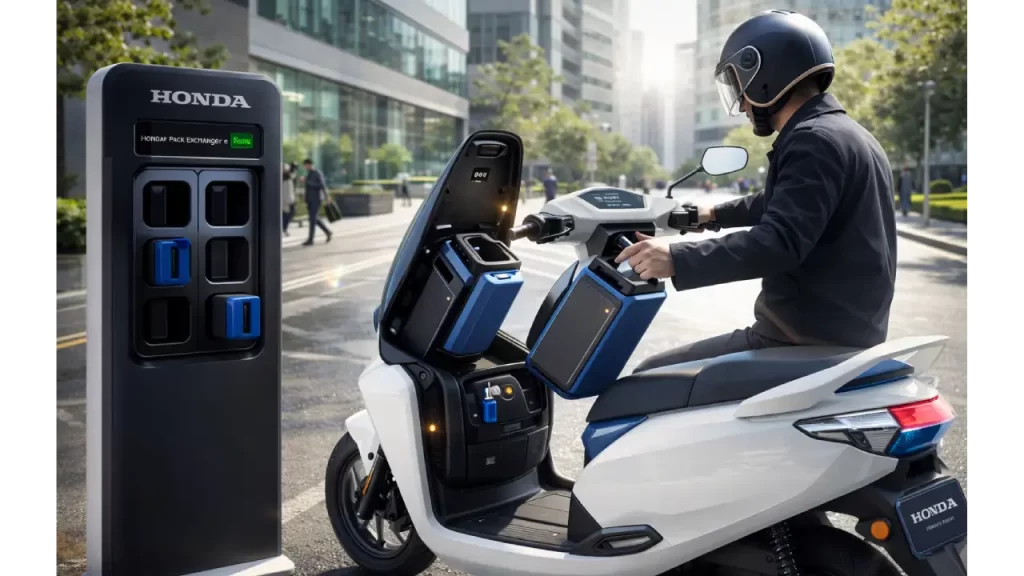
The headline innovation is its power system. Unlike most rivals, it uses two removable Honda Mobile Power Pack e: batteries. Each 10.2 kg battery can be charged at home or, crucially, swapped at dedicated stations in minutes, directly tackling charging anxiety.
The Connected variant is a tech hub. It boasts a large 7-inch TFT touchscreen powered by Honda RoadSync software. This system provides turn-by-turn navigation, call/SMS alerts, and over-the-air (OTA) updates. Performance is tuned for the city, with a 6 kW motor offering a top speed of 83 km/h and a WMTC-certified range of 72 km on a dual-battery setup.
Why It Matters
This launch is pivotal for Honda. Despite selling millions of petrol scooters like the Activa, the company has been notably slow to electrify its Indian lineup. The CUV e: is the clearest signal that Honda is now fully committed to the EV transition, aiming to convert its vast existing customer base.
More than just a product launch, Honda is introducing a new ecosystem. The company has established a battery-sharing subsidiary and has begun installing its Honda Power Pack Exchanger e: swap stations in major cities. This infrastructure-first approach could redefine convenience for urban riders and set a new competitive benchmark.
Expected Market Impact
The CUV e: will intensify competition in the premium scooter segment (₹1.2-1.4 lakh). It brings Honda’s legendary reputation for reliability and quality against rivals who have competed largely on specs and software.
Honda’s greatest weapon is its after-sales network. With over 6,000 touchpoints across India, it offers service accessibility no pure-play EV startup can currently match. This addresses a key consumer concern and could accelerate EV adoption among cautious buyers. The company’s commitment to local battery recycling further aligns with national sustainability goals.
Buyer Perspective
For Indian consumers, the CUV e: presents a compelling new choice. It is ideal for the urban commuter who values brand trust, build quality, and hassle-free ownership over having the absolute highest top speed or range.
The swappable battery system offers unmatched flexibility for those with secure parking or access to swap stations. While its estimated starting price of around ₹1.25 lakh (ex-showroom) places it at a premium, it justifies this with robust technology and Honda’s promise of long-term support. The success of its battery-swap model, however, will depend on the speed of network expansion.
The Road Ahead
The arrival of the Honda CUV e: marks the start of a new, more complex chapter for India’s EV market. Established global giants are now fully engaged, setting the stage for a battle that will hinge on product, price, and the seamless infrastructure that supports it. The ultimate beneficiary will be the Indian rider, who gains more innovative and reliable choices for clean urban mobility.