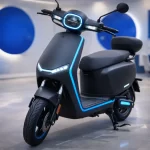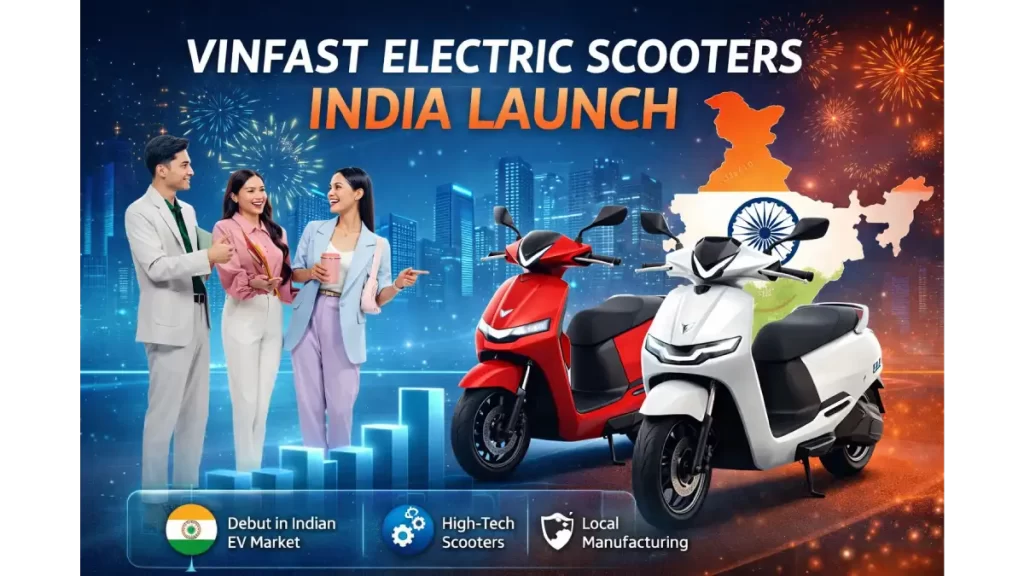

Vietnamese automotive giant VinFast has launched a major offensive in India’s most competitive electric vehicle segment. The company unveiled four new electric scooter models on January 15, marking a strategic pivot from premium electric cars to the high-volume, mass-market scooter space.
This launch follows the rapid scaling of VinFast’s local manufacturing plant in Tamil Nadu and represents a direct challenge to established Indian players like Bajaj, TVS, and Ather Energy on their home turf.
What’s New: A Four-Model Portfolio Built on Swappable Batteries
VinFast’s debut is a multi-pronged attack, offering models tailored to different riders with a core focus on swappable battery technology.
The lineup consists of three full-size electric scooters—the Viper, Feliz II, and Evo—all powered by durable LFP (Lithium Iron Phosphate) batteries that can be swapped in seconds at dedicated stations. The Evo is positioned as the flagship, boasting a potential range of up to 165 km when using two batteries. Alongside these, VinFast introduced the compact, pedal-assisted Amio, targeting students and ultra-short urban trips.
The true disruption lies in the supporting infrastructure. VinFast’s battery arm, V-Green, has activated its first 4,500 battery-swap stations and plans to install 45,000 battery-swap cabinets nationwide by the end of Q1 2026. The company claims this network will eventually be 1.5 times denser than petrol stations in covered areas, directly tackling range and charging anxiety.
Why It Matters: A Volume Play Backed by Massive Local Investment
This launch signals VinFast’s most ambitious play for the Indian market yet. Having entered with electric SUVs like the award-winning VF 6, the company is now targeting the segment that drives the vast majority of EV sales in the country.
The move is backed by serious capital and local commitment. In December 2025, VinFast signed an agreement with the Tamil Nadu government to invest an additional $500 million to expand its Thoothukudi facility. The plant is being tooled to eventually produce up to 1 million electric two-wheelers annually, a clear statement of intent to compete on scale and cost.
Expected Impact: Intensifying the Budget EV War
VinFast’s entry is poised to intensify the already fierce competition in the sub-₹1 lakh electric scooter market. The company’s “India-specific” strategy, emphasizing heavy localization, suggests it will compete aggressively on price.
Furthermore, the company’s massive bet on battery-swap infrastructure challenges the dominant home-charging model championed by current market leaders. This could spark a new phase of competition where charging convenience and network density become as important as the scooter’s specs.
Buyer Perspective: Convenience vs. Brand Trust
For Indian consumers, VinFast offers a compelling new proposition centered on ultimate convenience but from a new brand.
- The Swap Advantage: The ability to exchange a depleted battery for a fully charged one in minutes is a game-changer for apartment dwellers or anyone without private parking.
- Cost Flexibility: Buyers can choose to rent batteries via a monthly subscription or purchase them outright, allowing control over upfront costs.
- The New Kid on the Block: While VinFast’s cars have garnered positive reviews, its scooters are an unproven entity in India. Buyers will weigh the innovative swap network against concerns about long-term reliability, spare parts availability, and the maturity of the service network compared to decades-old Indian brands.
Real-World Experience & Expert Take
From an observer’s standpoint, VinFast’s scooter blitz feels less like a cautious market entry and more like a full-throttle highway merge. The focus on swappable batteries is clearly the headline act—and honestly, it addresses one of India’s most stubborn EV pain points: charging convenience. On paper, the ability to swap and ride in minutes sounds refreshingly practical, especially for urban users who treat parking spots like rare wildlife sightings.
However, seasoned Indian buyers are famously hard to impress. While the infrastructure promise is ambitious, real trust will be built only when riders consistently find those swap stations exactly where the company says they are. The scooters themselves appear sensibly positioned for mass adoption, but the true test will begin after the first few months of real-world usage—service experience, parts availability, and network uptime will quietly decide the winner.
In short, VinFast has made a bold and technically smart opening move. Now comes the part India cares about most: flawless execution without drama.
The Road Ahead
VinFast’s scooter launch is a bold attempt to rewrite the rules of India’s EV game. By combining aggressive local manufacturing, an unprecedented infrastructure rollout, and a competitively priced product range, the company is aiming for rapid market penetration.
The strategy’s success hinges on flawless execution of its complex swap network and its ability to build immediate trust with value-conscious Indian riders. The first customer deliveries for the Evo model begin in February 2026, which will be the true test of whether VinFast’s high-stakes bet will pay off.
Sources & Verification: This report is based on VinFast‘s official press release dated January 15, 2026, and subsequent coverage from financial and automotive news outlets. Details regarding the Tamil Nadu plant expansion are from the company’s December 2025 MoU announcement with the state government.