
Every weekday morning across Indian towns and cities looks similar. A parent balances a school bag on one shoulder, another checks the traffic update, and a scooter waits outside the gate. In 2026, these everyday scenes reveal a quiet shift in thinking. Speed is no longer the first question many riders ask. Mileage is.
As petrol prices hover around triple digits and roads remain crowded, Indian scooter users are reassessing what actually helps them get through the day.
Daily Reality
For most riders, the scooter is not a weekend machine. It is a daily tool. Office commutes, school runs, market trips and short errands rarely stretch beyond 40–50 km in a day. According to industry observations, this pattern holds true across metros and small towns alike.
In such conditions, outright speed often goes unused. Traffic signals, potholes and congestion naturally limit average speeds, regardless of what the speedometer promises.
Traffic Truth
Urban traffic dictates its own rules. Early indications suggest average moving speeds in busy areas remain between 25 and 35 kmph. Even petrol scooters capable of higher speeds spend much of their time braking and accelerating in short bursts.
Electric scooters operating at moderate speeds often match these real-world conditions more comfortably. The smooth, linear response at low speeds suits stop-and-go traffic, without demanding extra effort from the rider.
Range Comfort
Mileage, in practical terms, means peace of mind. Many families now look for a scooter that can handle an entire day without refuelling or recharging worries. As per reports, this “full-day confidence” has become a key talking point among urban users.
Electric scooters with higher real-world range allow riders to finish work, pick up children, and handle evening errands without planning another stop. Petrol scooters still offer quick refuelling, but rising fuel costs make frequent visits more noticeable in household budgets.
Cost Awareness
Fuel spending is no longer an abstract idea. Families see it weekly. Claimed figures suggest that electricity costs for daily charging remain far lower than petrol expenses for similar distances. Over time, this difference shapes opinions more than acceleration figures.
Petrol scooters retain a sense of reliability, especially in areas with limited charging access. Yet, the monthly cost gap is difficult for cost-conscious households to ignore.
Family Lens
Families evaluate scooters differently than solo riders. Parents consider stability, ease of handling, and predictability. Lower speeds feel safer in crowded lanes, especially when children are frequent passengers.
Seat height, balance at low speeds, and quiet operation also influence decisions. Many riders note that silent operation reduces stress during early mornings and school hours, even if it lacks the familiar engine sound.
Design Feel
Visually, electric scooters in 2026 look more refined than earlier models. Displays are clearer, lighting is sharper, and the ride feels calmer in traffic. Petrol scooters continue to offer a familiar design language that many families trust.
On the road, the difference is subtle but noticeable. Electric scooters feel relaxed at city speeds, while petrol scooters feel more confident once roads open up.
Speed Limits
Speed still matters, but selectively. Delivery riders and highway users often prefer quicker acceleration and higher top speeds for overtakes. For them, petrol scooters or higher-speed electric models remain relevant.
However, observational data suggests these users form a smaller share of total buyers. Most households prioritize predictability over performance they rarely use.
Urban Choice
In cities, electric scooters increasingly fit daily routines. Home charging blends into night schedules, much like charging a phone. As charging networks expand, confidence continues to grow.
In smaller towns and rural areas, petrol scooters still dominate due to infrastructure familiarity. This divide reflects practicality rather than preference.
Observed Shift
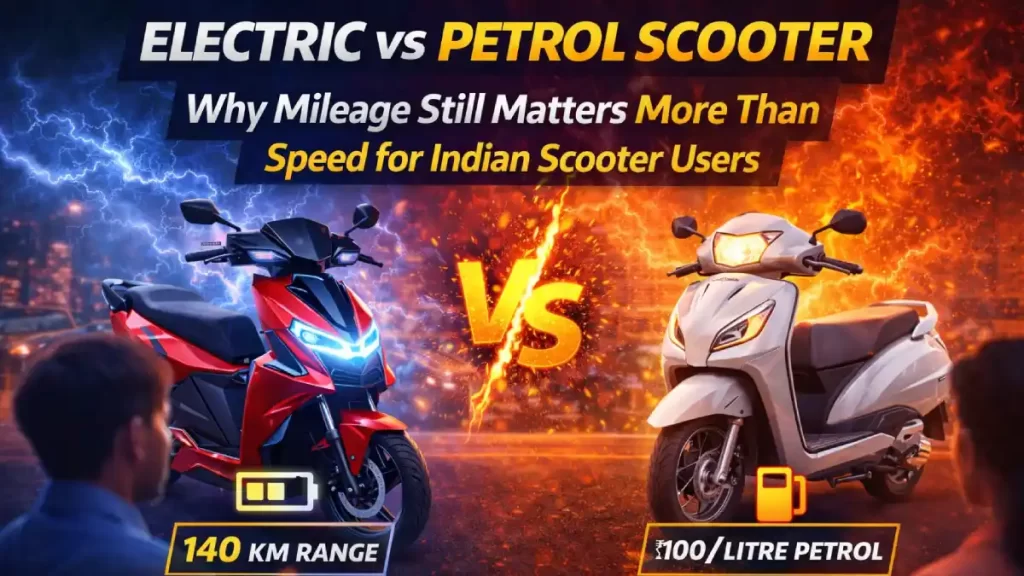
The ongoing discussion between electric scooter vs petrol scooter choices in India is less about technology and more about lifestyle. Riders are aligning their choices with how they actually travel, not how vehicles are advertised.
Speed sells attention. Mileage supports routine.
Conclusion
In 2026, Indian scooter users appear more grounded in their decisions. For daily commutes shaped by traffic, fuel prices and family needs, mileage often feels more valuable than speed.
The question many households ask is simple: will this scooter get us through the day comfortably? In that answer, range continues to matter more than numbers on a spec sheet.
Do share this perspective with others who navigate similar daily commutes and family travel choices.