
Every morning across India begins the same way.
A scooter rolls out of a narrow lane, a school bag hangs from the hook, and a parent checks the road ahead. For millions of households, scooters are not about style or speed. They are about getting through the day.
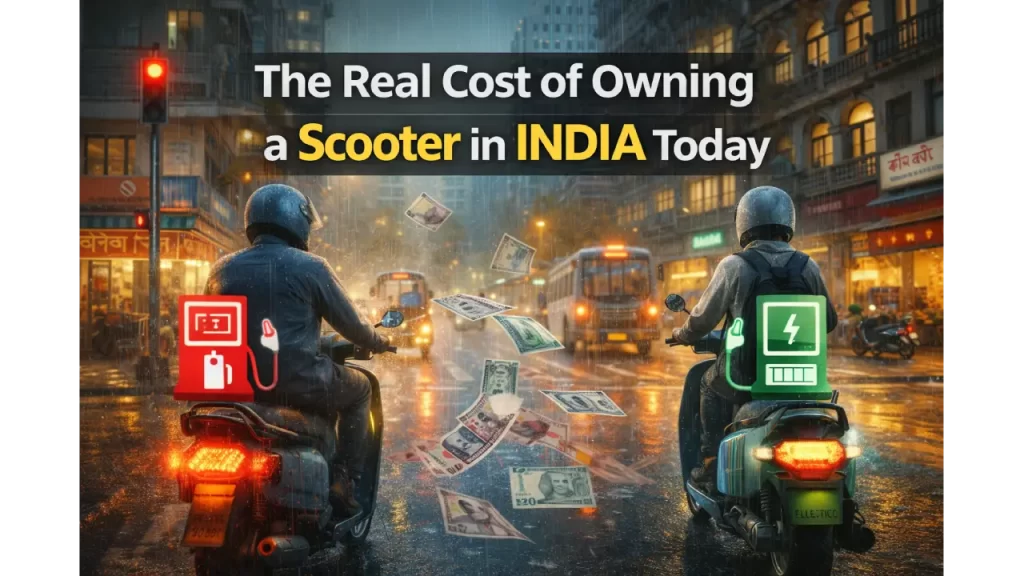
In 2026, this everyday routine has pushed Indian families to think more deeply about ownership costs, especially as electric scooters become more visible on city roads.
Daily Dependence
Scooters remain India’s most practical form of personal transport.
They fit into tight parking spaces, move easily through traffic, and handle short daily distances better than most vehicles.
According to industry observations, the average Indian scooter covers less than 40–50 km a day. Office commutes, school drops, market visits, and evening errands define usage more than long highway travel.
Fuel Pressure
Rising petrol prices have made daily running costs harder to ignore.
What once felt like small refuelling amounts now add up clearly by the end of the month.
Many households now track fuel spending closely, especially those relying on a single vehicle. As per reports, fuel cost uncertainty has become one of the biggest stress points in scooter ownership.
Electric Shift
Electric scooters entered this discussion quietly.
They did not replace petrol scooters overnight, but they introduced a different cost structure that appealed to daily commuters.
Charging at home overnight changed how families think about travel expenses. Electricity bills feel more predictable than fuel prices, and for regular riders, the difference shows up quickly in monthly calculations.
Running Reality
In everyday use, electric scooters generally cost far less to run per kilometre than petrol scooters.
This gap becomes most visible for riders who travel daily and follow fixed routes.
According to industry sources, families with consistent commuting patterns find electric scooters easier to budget for, even if charging requires planning.
Petrol scooters still offer flexibility, but their daily costs fluctuate more with market conditions.
Maintenance View
Ownership costs are not limited to fuel or charging.
Maintenance plays a major role over time.
Electric scooters have fewer mechanical parts. They do not require oil changes, engine tuning, or regular filter replacements. This often reduces routine servicing expenses.
Petrol scooters, however, benefit from widespread service networks and decades of familiarity. Many riders trust the ease of finding roadside help, especially outside major cities.
Traffic Reality
Indian traffic shapes ownership experience more than brochures do.
Congestion, signals, and uneven roads keep average speeds low for most of the day.
In this environment, steady performance matters more than top speed.
Electric scooters, with smooth acceleration and silent movement, often feel better suited to stop-and-go traffic.
This real-world usage explains why many buyers prioritise simplicity over advanced features.
Feature Balance
Modern electric scooters offer digital dashboards, app connectivity, and smart alerts.
However, early indications suggest that many everyday riders do not rely heavily on these features.
For families focused on routine travel, reliability and ease of use matter more than screens or software updates. Simpler electric scooters often feel less intimidating to maintain and understand.
Small-Town View
In smaller towns and semi-rural areas, ownership priorities differ.
Longer distances, irregular charging access, and dependence on local mechanics keep petrol scooters relevant.
That said, electric scooters are slowly entering these markets as charging options improve. The shift is gradual and shaped by practicality rather than trend-following.
Safety Perception
Safety concerns influence ownership costs in subtle ways.
Electric scooters are quieter and smoother, which some riders associate with reduced fatigue in traffic.
At the same time, battery longevity and charging reliability remain emotional concerns for many families. Trust builds slowly, often after seeing neighbours complete multiple years of trouble-free use.
Policy Influence
Government incentives and state-level EV policies have played a role in reducing ownership costs.
Subsidies and charging infrastructure plans are expected to continue influencing adoption patterns.
According to reports, future policies may focus more on daily commuters and gig workers, aligning electric scooters more closely with real-world usage.
Observed Trade-Off
There is no single answer for every household.
Petrol scooters offer familiarity and flexibility. Electric scooters offer predictability and lower daily expenses.
The choice reflects lifestyle more than technology. Urban families with fixed routines lean toward electric. Mixed-use or long-distance riders still prefer petrol.
Quiet Conclusion
The real cost of owning a scooter in India today is not decided at the showroom.
It reveals itself in monthly budgets, service visits, and daily routines.
Electric scooters have reshaped how Indian families calculate ownership, not by promising innovation, but by changing everyday expenses. As traffic, fuel prices, and urban living continue to evolve, scooter decisions remain practical, personal, and quietly thoughtful.
Do share this perspective with others who navigate similar daily commuting choices.